Live Dream Catcher Casino UK: How It Works
 Available in GB
A practical look at the streamed studio format, how betting works, and the checks and limits to consider before playing.
Table of Contents
- What a Live Dream Catcher Session Actually Involves
- Playing Online in the UK: Check the Licence First
- What to Look For Without Falling for “Best” Claims
- Playing the Game: Pace, Stakes and Staying in Control
- The Wheel, Roulette and the Rules You Shouldn’t Mix Up
- Choosing a Live Casino Site Without a Sales Pitch
- Trying a Demo? Know What Free Play Does Not Do
- A Sober Review: The Trade-Offs Behind Live Play
- Before You Play Live, Set Your Limits
What a Live Dream Catcher Session Actually Involves
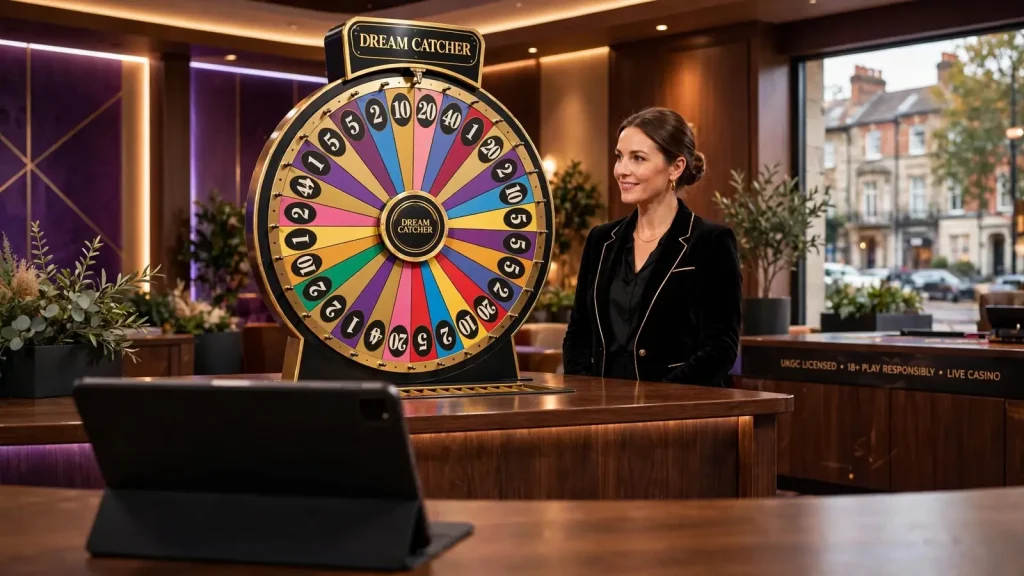
A live Dream Catcher session is a streamed casino game, not a video of a previous round and not simply a digital animation running on your device. You see gameplay broadcast in real time from a studio, where a human dealer is present. You make your bets through the on-screen interface while the session is underway. That combination is what “live” means here: a real person and a real-time studio feed, paired with digital controls on your screen.
The distinction can sound obvious until you sit down to play. On a standard computerised game, the action is generated by software and presented on screen. In a live casino, the camera feed shows a studio session as it happens. Your device is still doing plenty of work: it displays the stream, shows the betting controls and sends your selections through the interface. But the dealer and the gameplay you are watching are not just characters in an animation.
I used to treat the word “live” as if it meant I was somehow sitting at a physical table. It doesn’t. You are watching a broadcast and interacting digitally. That is a more useful way to picture it: part studio, part screen, with your bet entered through the controls rather than spoken to a dealer across a table.
If you’re looking for live Dream Catcher casino options in the UK, payout speed is one practical detail to consider. Use this list as a reference, and check that the game is available to you before playing.
1. Jetsetspins
Payout speed: 1-3 business days Jetsetspins lists a payout speed of 1–3 business days, giving you a stated timeframe to consider.
2. Amunbet
Payout speed: 1-3 business days Amunbet lists payouts as taking 1–3 business days, a useful detail for your comparison.
3. Revery Play
Payout speed: 1-3 business days Revery Play gives a payout speed of 1–3 business days, so you have a stated timeframe to keep in mind.
4. EvoSpin
Payout speed: 1-3 business days EvoSpin lists a payout speed of 1–3 business days. This gives you one practical detail to consider.
5. Britsino
Payout speed: 1-3 business days Britsino’s listed payout speed is 1–3 business days, which may help you assess the practical side of playing.
6. SlotoSport
Payout speed: 1-3 business days SlotoSport lists payouts as taking 1–3 business days, giving you a clear timeframe to note.
7. x3bet
Payout speed: 1-3 business days x3bet lists a payout speed of 1–3 business days, a stated detail you can factor into your choice.
8. WinBeast
Payout speed: 1-3 business days WinBeast gives a payout speed of 1–3 business days, so you can take this timeframe into account.
9. NightLuck
Payout speed: 1-3 business days NightLuck lists its payout speed as 1–3 business days, giving you a useful point of reference.
10. NightWin
Payout speed: 1-3 business days NightWin lists payouts as taking 1–3 business days, a timeframe for you to consider.
What you see, and what you control
The studio footage gives you a view of the live session and its human dealer. The interface is where you place bets. These are connected parts of the experience, but they are not the same thing. The stream lets you watch; the controls let you take part.
That separation matters because a live picture can make the experience feel more immediate than a fully computerised game. The dealer is there on camera, and the session unfolds in real time. At the same time, you are not physically handling anything or making your selection by pointing at a table. Your choices are made using the on-screen interface.
When I first tried live games, I paid more attention to the video than to the controls. It is easy to do: a person on camera naturally draws your eye. But the interface is the part you use to participate. Take a moment to see how it is arranged before treating the stream as the whole game. A live picture does not remove the digital layer; it sits alongside it.
This is also why the phrase “live Dream Catcher casino” can cover a particular kind of experience without telling you every detail about how a session works. The defining feature is the live-dealer format. The stream comes from a studio, a human dealer is involved, and bets are entered through the screen. The exact layout and presentation can depend on the service you are using, so it is better not to assume that every screen will look identical.
Why it feels different from a computerised game
A computerised game presents the action through software. A live dealer game adds a real-time studio feed and a person dealing with the session in front of the camera. That changes the feel of play even though you are still using a digital device to make your selections.
Live Baccarat Online Casinos in the UK
For me, the appeal is mostly about seeing the session unfold rather than having every part of the experience represented by graphics. There is a person on screen, and what you are watching is happening as you watch it. That can make the game feel closer to a casino setting. It does not mean you are physically at a casino, though, and it does not turn the interface into a real table in front of you.
There is a small but important difference between “watching live” and “being there”. The dealer is in the studio; you are viewing the broadcast from wherever you are playing. Your participation happens through the controls. Keeping that straight helps set expectations. It is a live stream with an interactive betting layer, not a face-to-face visit.
If you are looking up Dream Catcher casinos in the UK, the format is the first thing to understand before getting lost in labels. The words may sound like a product description, but the practical idea is simple: you watch a human dealer in real time and enter bets using an on-screen interface. That is the basic structure of a live casino Dream Catcher session. It tells you what “live” refers to, not what every particular screen or table will look like.
5-Reel Slots in the UK: How Bets and Demos Work
I find that distinction more useful than the glossy language around live play. A studio feed can add a human presence, but you are still interacting through software. The dealer does not see you sitting at home; your choices reach the game through the interface. So the experience is neither a plain computer animation nor a physical casino visit. It sits between those two things.
That is the format in a nutshell: real-time footage, a human dealer and digital betting controls. The stream gives you the view; the interface is how you take part. No mystery there.
Playing Online in the UK: Check the Licence First
If you are looking for a live Dream Catcher table, the first question is not whether the game appears on a screen. It is whether the operator offering it is authorised to serve people in the UK. Live dealer casinos can operate legally here when they hold a licence from the UK Gambling Commission. That licence is the basic legal check; a polished site, familiar game name or confident “UK players welcome” message is not a substitute.
Casino Dice Games in the UK: How They Work
The distinction matters because an operator’s location does not decide whether it needs permission to serve the British market. A remote gambling business selling to customers in Great Britain must hold the relevant Gambling Commission licence, even if the company itself is based elsewhere. An offshore casino without a UKGC licence sits outside that regulatory system. It may still be reachable online, but being able to open a page is not the same as being on a licensed site.
I used to treat a working website as a sort of unofficial green light. That was a lazy shortcut. Access tells you only that the page loaded; it does not establish that the operator is permitted to offer real-money gambling here. The check should be about the business running the casino, not just the live game title or the studio footage. A game can be available through one licensed operator and absent from another, but the UK licensing requirement applies to the operator serving the customer.
Aviator Casino Game in the UK: Licensing and Play
For a practical check, use the UK Gambling Commission’s own website and look up the operator’s licence status. Make sure the name shown there matches the business behind the casino you are using. A logo or line of text on a site is easy to display; it is not the same as independently confirming that the operator holds a current UKGC operating licence. If the business name is unclear, that is a reason to pause rather than fill in the blanks yourself.
This is not paperwork for its own sake. In the UK, online gambling is legal for adults at sites that are licensed and regulated. The licence is the dividing line between a casino operating within the local regulatory framework and one that does not hold UK permission. The Gambling Act 2005 governs gambling in England, Wales and Scotland, while Northern Ireland has a different legal framework. For a customer looking at an online casino serving the British market, the UKGC requirement remains the key operator check.
Licence Check
A remote gambling business serving Great Britain must hold a UK Gambling Commission licence; an offshore casino without one sits outside the regulatory system.
Age is the other part of access, and it comes before depositing. Online gambling is for people aged 18 and over, and operators must verify a customer’s age before allowing money to be deposited into a gambling account. So registration is not simply a matter of choosing a username and moving straight to payment. The operator has to establish that the customer meets the age requirement before deposits are allowed.
That check is the operator’s responsibility, not a favour or an optional extra. If you are asked to provide information as part of verification, treat it as part of the account-access process rather than assuming the site has already confirmed everything because you reached a game lobby. If the operator has not completed the required age check, you should not be able to deposit. And being over the age threshold does not make an unlicensed casino acceptable: age and licensing are separate conditions.
I would keep the order simple: confirm the operator’s UKGC status, then make sure the age-verification process is complete before any deposit. Neither check tells you whether a particular table suits you; they establish whether you are dealing with an operator permitted to serve the market and whether you meet the legal age requirement. That is a narrower test than an endorsement. A licence is not a promise that you will enjoy the experience or win money.
Online Casino Tournaments UK: Rules and Scoring
Searches for a Dream Catcher casino online can bring up pages that use similar wording while being run by different businesses. Do not assume that a game name identifies the operator, or that every result offering the same live title has the same regulatory status. Check who is actually providing the gambling service. If the operator cannot be identified clearly, or you cannot confirm its licence through the Commission, do not treat the appearance of the game as proof that the site is authorised.
I know the temptation to skip this and get straight to the table. The game is the visible part; the operator’s legal status is less exciting, but it is the part worth checking first. This section is for entertainment purposes only, not gambling advice.
What to Look For Without Falling for “Best” Claims
“Best” sounds like a verdict. In practice, it often tells you more about the person making the claim than about whether a live Dream Catcher table will suit you. I’d rather look at the parts of the experience that can affect an ordinary session: how quickly things move, what the entry stake feels like, and whether your connection can keep the stream steady.
That is less exciting than a ranked list. It is also more useful.
Decide whether the pace suits you
Live games tend to move more slowly than digital versions. There is a real-time stream to follow, and the game does not simply jump from one result to the next at the speed of a button press. If you enjoy seeing events unfold, that can be the point. If you want quick rounds with little waiting, the pauses may become irritating.
Pace of Play
Live games move more slowly than digital versions because they rely on a real-time stream and a human dealer rather than software-generated jumps.
I have caught myself mistaking a slower game for a more thoughtful one. It can feel that way, because there is more time between decisions and outcomes. But waiting does not make a game easier to predict or improve the chance of a result. It just changes the rhythm.
Think about what you actually want from the session. Do you like having time to watch, or do you find yourself reaching for another screen the moment there is a pause? If the second sounds familiar, a live table may hold your attention less comfortably than its presentation suggests. “Immersive” can mean absorbing; it can also mean that you are sitting through every interval.
Look at the stake before settling in
Live tables have higher minimum bets than digital games. That difference matters even if the table looks appealing and the interface feels simple. The minimum is not a decorative detail: it determines whether the game’s pace and presentation are available at a level that feels comfortable to you.
I would not assume that a table is suitable just because it appears in a live casino lobby. Check the minimum shown for the specific table, then ask yourself whether it fits the kind of session you intended to have. A number that seems small in isolation can feel different when rounds arrive more slowly and you remain at the table longer than planned.
Live Casino Lightning Roulette in the UK: How It Works
There is no universal minimum that makes a table right for everyone. What matters is the actual stake displayed and your own comfort with it. If the entry point already feels like pressure, the polished studio and friendly interface do not change that. “Accessible” is a sales word; the number on the table is what counts.
This is not about finding the lowest possible figure and treating it as permission to play. It is about checking the practical terms of the experience before you commit your attention to it. A live game can be a poor fit simply because its minimum is above what you wanted to stake, regardless of how well it is presented.
Test the connection honestly
A live table depends on a stable internet connection. That is easy to overlook when the stream is running smoothly, but a picture that freezes or falls behind can make the whole experience frustrating. You are not just loading a static game screen; you are watching a live feed while using an on-screen interface.
Before deciding that a table is for you, consider where and how you expect to play. If your connection is unreliable in that setting, the live format may not be a good match. A brief test of the stream can tell you whether the picture and sound remain usable, but do not mistake one smooth moment for a guarantee that the connection will stay stable.
I once treated buffering as a minor nuisance and kept going anyway. It was not a clever way to spend a session. When the image and the action stop lining up cleanly, the table becomes harder to follow and less enjoyable. No studio set can fix a weak signal.
Attention A stable internet connection is essential for live play, as buffering or a frozen stream can make the session frustrating and harder to follow.
Ignore the borrowed superlatives
When you see a claim that a particular live Dream Catcher casino is “best”, look for what the claim actually measures. Does it describe the pace, show the table minimum, or say anything concrete about stream quality? Or does it mostly stack up confident adjectives?
A phrase like “best live Dream Catcher casino UK” might sound precise, but it does not tell you whether the table runs at a pace you enjoy, whether its minimum suits you, or whether your connection can handle the stream. Those are personal fit questions, not a universal ranking.
My own filter is plain: read the details, imagine the session as it would really feel, and leave the hype out of it. A live table is not automatically a better experience because it looks more like a studio production. It has trade-offs. More waiting, a higher entry stake, and a connection that has to hold up.
That is the useful comparison: not one vague “best” against another, but the format against what you actually want from it.
Playing the Game: Pace, Stakes and Staying in Control
A live game asks you to settle into a different rhythm from a digital one. The rounds move more slowly, and there is less sense of tapping straight into the next result. In a Dream Catcher live casino game, that slower pace is part of the format, not a sign that anything has gone wrong. It can feel more absorbing, but it also means you need to be comfortable waiting between decisions.
Mines Casino Game in the UK: Licensing and Play
I used to treat waiting as dead time and fill it by placing another bet. That is an easy way to lose track of what you have chosen to spend. A live table may have higher minimum bets than its digital counterpart, so check that the stake you want to use is actually available before you start. If the minimum feels too high for your budget, stepping away is a better choice than raising your stake to fit the table.
Set your total budget before opening the game, and decide what you will do when it is gone. Keep that figure separate from money needed for everyday expenses. While playing, take a moment to notice how much you have already staked; the stream can make the session feel like a social activity rather than spending money. It is still gambling. The camera and dealer do not change that.
The temptation to chase can arrive in either direction. After a loss, you may want to stake more to get back to where you started. After a win, you may feel that the extra balance is free to risk. I have made both mistakes. A win does not make a larger bet safer, and a loss does not create a reason to keep playing. Stick to the limit you set, rather than letting the last result make the decision for you.
Connection matters, too. Live games need a stable internet connection, and a broken stream can interrupt the experience at an awkward moment. If the picture freezes or the connection drops, pause rather than hurriedly making further decisions. Take time to see what the screen shows and what the game is asking you to do before continuing. A steady connection will not make a bet a good one; it simply helps you follow the live session.
Do
- Set a total budget before opening the game
- Stick to your limits regardless of the last result
- Take short breaks to evaluate your plan
Don’t
- Use money needed for everyday expenses
- Chase losses by staking more to recover funds
- Let a win encourage larger, riskier bets
If you are going to play Dream Catcher, give yourself room to stop. You do not need to keep a session going because you have already spent time on it, and you do not need to make every round count. Short breaks can help you notice whether you are still following your own plan or just reacting to the previous result. If you feel annoyed, rushed or eager to win back money, stop for the moment.
Live play can be enjoyable as entertainment, but it is not a way to make money. Keep the stakes within the budget you chose, and leave the game when that boundary is reached. That is the part you control.
The Wheel, Roulette and the Rules You Shouldn’t Mix Up
The word “wheel” can make different casino games sound more alike than they are. A roulette wheel belongs to roulette. It does not tell you how Dream Catcher works, what its rules are, or whether it uses a roulette wheel at all. I’ve caught myself carrying assumptions from one game into another; that shortcut is an easy way to misunderstand what you’re watching.
In live roulette, a dealer spins a physical wheel and the ball lands in one of its numbered pockets. Computerised roulette produces its result using a Random Number Generator instead. Both formats present roulette, but the result comes about differently: one is filmed play with a real wheel, the other is generated by software. Seeing a dealer on screen is not, by itself, a reason to assume the odds match every other roulette table.
Crazy Time Live Casino Game Show UK Guide
Wheel format matters too. American Roulette has a green pocket marked 0 and another marked 00. European Roulette has a single green 0 pocket. That extra pocket changes the chance of a winning selection: the stated odds are one in 38 in American Roulette and one in 37 in European Roulette. Small difference in the layout. Meaningful difference in the maths.
That comparison is specifically about American and European Roulette. It is not a description of Dream Catcher, and those roulette odds should not be carried over to a different game just because its name or presentation involves a wheel. The game’s own rules and paytable are what count. Keep the categories separate.
There is another detail worth keeping straight: a roulette result is the number where the ball comes to rest. A bet wins when it matches the number selected. How a particular bet is assessed depends on the roulette rules and the table format; a physical wheel does not make every bet equivalent, nor does a familiar-looking screen prove that two games use the same setup.
So if you’re looking at a live Dream Catcher table, don’t use roulette comparisons as a substitute for reading that game’s instructions. Live roulette means a dealer spinning a physical roulette wheel. Computerised roulette uses an RNG. American and European Roulette differ in their green pockets and stated winning odds. Those are useful distinctions, but they answer roulette questions only.
I learned this the dull way: recognise the game before borrowing rules from another one. Check what the displayed game actually says, rather than filling in the gaps from a wheel you already know. Same broad casino setting; different rules.
Roulette vs Dream Catcher
While both may involve a wheel, they differ fundamentally. Live roulette involves a ball landing in numbered pockets with specific odds (e.g., 1 in 37 for European), whereas Dream Catcher has its own distinct rules and paytable.
Choosing a Live Casino Site Without a Sales Pitch
A polished page can make a live Dream Catcher table look like a sure thing. It isn’t. I’ve learned to ignore the banners for a moment and look for the details that tell me what I’m actually being offered.
Start with the operator’s licence. Live dealer casinos can operate legally in the UK when they hold a UK Gambling Commission licence. Check the operator’s own licensing information and confirm it against the Commission’s register; don’t treat a logo or a line of small print as proof on its own. The name on the site should match the licensed business. If you can’t establish who is taking your bets, stop there.
Then find the game’s own rules and paytable before you play. Read what counts as a win, how the available bets are settled and whether any special features have separate conditions. A colourful interface can make a game feel self-explanatory, but it doesn’t replace the rules. I’ve clicked through too quickly before and only noticed the important detail after I’d started. Annoying, and avoidable.
Look for information that is easy to reach and written plainly. If the rules are missing, hard to follow or seem inconsistent with what the table displays, don’t guess. Contact support and wait for a clear answer before staking money. A confident-sounding chat reply is not a substitute for written game rules.
Chicken Road Game in UK Casinos: What to Know
Also check the practical safeguards around the account: whether the operator explains its policies clearly and provides a way to get help if something goes wrong. Don’t confuse a busy live lobby or a prominent promotion with evidence that a site is suitable for you. Those are presentation choices, not proof of fair terms.
My simple test is whether I can verify who operates the site, find the relevant rules and understand the paytable without being pushed towards a deposit. If not, I leave. There are other tables.
This is entertainment, not gambling advice. No site check removes the risk of losing money, and a licence does not make a particular game a good choice for you. Take the time to read what applies to the table itself before deciding whether to play.
Trying a Demo? Know What Free Play Does Not Do
A free-play version can be useful for getting familiar with an interface, if one is offered. You can see how the controls are arranged and what happens when you make a selection, without staking real money. That can take some of the awkwardness out of trying an unfamiliar game.
But a demo is not the same as playing for cash. Any balance shown in free play is not money you can withdraw, and a result there does not create a real payout or a claim to winnings. I learned not to treat a demo balance as if it were a small bankroll. It isn’t. It’s part of the practice environment.
Demo Limits
Any balance shown in a free-play version is for practice only and cannot be withdrawn as real money.
That distinction matters when you’re wondering whether there is a Dream Catcher casino demo. Availability can depend on the operator and the version of the game it provides, so don’t assume that a free-play option exists. The same goes for a live casino demo: the words “live” and “demo” do not, by themselves, tell you what is actually being offered. Check the game page and its terms rather than taking a label as a promise.
A demo may also be different from the real-money experience. It can help you recognise the controls, but it cannot show you what it feels like to stake your own money or guarantee that the live experience will behave in a particular way. Don’t use practice results to predict what will happen later. Each real-money decision stands on its own.
If there is no free-play option, that does not mean you need to deposit just to find out how the game works. You can read the available rules and information before deciding whether to play at all. And if you do move from free play to real money, treat that as a separate decision, not as the next step in a session you have already started.
I’ve made that mental leap before: “I’m only trying it.” That phrase can make real spending feel like an extension of harmless practice. It isn’t. Free play is for familiarisation, not earnings, and it is for entertainment only—not gambling advice.
A Sober Review: The Trade-Offs Behind Live Play
A fair Dream Catcher live casino review has to weigh what the format adds against what it asks of you. The live setup can feel more present than a digital version, but that does not automatically make it a better fit. For me, the useful question is whether the pace, stakes and connection demands suit the way I actually want to play.
JetX Casino Game in the UK: A Cautious Guide
The pace is the first trade-off. Live games move more slowly than digital versions, so there is more waiting between decisions and outcomes. That can make a session feel less rushed, but it can also test your patience if you came for quick rounds. I used to mistake a slower game for a calmer one. They are not the same thing: waiting does not, by itself, change the risk or make a session easier to manage.
The starting stake matters just as much. Live games have higher minimum bets than their digital counterparts, which can make each round feel more consequential. A minimum that seems manageable on screen can still be uncomfortable once you are actually playing. That is not a flaw in the presentation; it is a practical cost of choosing this format. If the required stake does not feel comfortable, the live experience may simply not suit you.
Then there is the connection. A stable internet connection is needed to follow live play properly. If your stream keeps breaking up or your connection drops, the session becomes frustrating rather than immersive. It is worth being honest about your setup before treating the live format as an upgrade. A polished studio cannot fix a shaky connection.
So my review is mixed by design. Live play may appeal if you value a slower rhythm and the sense of a real-time session. It may be a poor fit if you want rapid rounds, lower entry stakes or a format that does not depend on steady streaming. None of those preferences makes one choice smarter than another; they just change what you get from the experience.
Live Play Trade-offs
- Slower pace with more waiting between rounds
- Higher minimum stakes compared to digital games
- Dependency on a stable, high-quality internet connection
- Human presence provided by a real-time studio feed
I would not call the format “better” simply because it looks more like a casino. That word skips the useful details. Pace, minimum stake and connection quality are the trade-offs to weigh before you decide whether live Dream Catcher suits you. This is entertainment, not gambling advice.
Before You Play Live, Set Your Limits
Before you play Dream Catcher live, decide what you can afford to lose and treat that amount as the cost of entertainment, not money you expect to get back. Set the budget before opening the table, while you can still think clearly. Once it is spent, stop. I have made the mistake of treating a budget as a suggestion after a session went badly. It is a poor time to renegotiate with yourself.
It helps to choose a stopping point as well as a spending limit. If you reach either one, leave the game rather than adding funds or stretching the session. A win is not a reason to keep going until it disappears, and a loss is not a debt the next round needs to repay. The result of a previous bet cannot promise what comes next.
Keep gambling money separate from cash needed for bills, food or other essentials. Don’t borrow to play, and don’t use a credit card for gambling. If you feel irritated, rushed or determined to win back what you have lost, that is a good moment to step away—not to raise your stake or extend your limit.
I used to think I could make one last decision after the session had already started. In practice, that was when my judgement was least useful. Make the decision beforehand and write it down if that helps. Simple rule.
Live play is for entertainment, not a way to make money, and this is not gambling advice. If sticking to your limits feels difficult, pause rather than trying to solve it with another session. A plan only works if you follow it.
3-reel slots in the UK: what to check
Bonuses and Live Tables: Read the Terms Before Opting In
A welcome offer can look relevant to a live table and still have nothing to do with it. A specialist review of UK promotions described free spins on slots as the main form of welcome offer it found, and noted that these could not be used at live tables. That is a report about the offers reviewed, not a rule for every operator. If you are considering an offer while hoping to play Dream Catcher, check the promotion’s own terms rather than assuming the game qualifies.
The key detail is often game weighting: how much a particular game counts towards the wagering requirement attached to a bonus. Live games may contribute only a small share; one stated example is 10%. That can make a promotion far less useful for live play than its headline suggests. Check whether Dream Catcher is eligible and how its contribution is defined before opting in. A game being available in the casino does not mean it counts towards bonus wagering.
Read the wagering requirement alongside the weighting, not in isolation. Then look for any maximum-bet condition that applies while bonus funds are active. If your stake exceeds the stated cap, the terms may affect whether you can keep the bonus or related winnings. The exact conditions depend on the offer, so don’t fill in the gaps from what another site does.
I’ve made the mistake of treating the bold offer as the important part. It isn’t. The small-print conditions decide whether the promotion fits the way you intend to play, and whether live-table activity helps at all. If the terms are unclear, ask the operator before opting in; once you accept, you may be bound by conditions you had not noticed.
This is entertainment, not gambling advice. Read the promotion terms before accepting an offer.
How do you play live roulette?
You place bets through the on-screen controls while a live dealer spins a physical wheel. You win if the ball lands on a number you selected.
What are the different types of roulette you can play with a live dealer?
Live dealer roulette can include European, American and French Roulette. American Roulette has both 0 and 00, while European Roulette has a single 0; in French Roulette, an even-money bet loses only half when the ball lands on zero.
How can you win live dealer roulette?
You win when the ball lands on a number covered by your bet. European Roulette has odds of 1 in 37, compared with 1 in 38 in American Roulette.
How do you choose a live dealer casino?
Choose an operator with a UK Gambling Commission licence if you are playing from the UK. Check the licence rather than relying on the site’s appearance or claims that it welcomes UK players.
What is the difference between European and American Roulette?
American Roulette has two green pockets, 0 and 00, while European Roulette has one, 0. The odds of winning are 1 in 38 in American Roulette and 1 in 37 in European Roulette.

Aviator Casino Game in the UK: Licensing and Play
Aviator’s availability does not establish UK authorisation; the operator’s licence, game format and terms shape...

3-reel slots in the UK: what to check
A practical guide to screen usability, real-money risks, classic reels, demo limits and the odds...

5-Reel Slots in the UK: How Bets and Demos Work
Five-reel slots bring reels, symbols and a stake together in one game cycle; the layout...

Bonus-buy slots in the UK: what to check
A bonus buy provides direct entry to a feature round, while outcomes still follow the...

Keno Payouts and Fast Casino Withdrawals in the UK
Keno returns depend on your selections, the draw and the game’s paytable, not on how...

First Deposit Bonus Casinos in the UK: What to Check
A first-deposit label only marks when an offer applies; its value depends on the reward...

High-Volatility Slots in the UK: What to Expect
High volatility describes a payout pattern: wins may come less often, and a larger result...

Online Keno Casinos in the UK: What to Check
A practical look at number picks, random draws, paytables, free play and the conditions attached...

Live Casino UK: Comparing Tables, Licensing and Bonuses
Live tables combine a video stream with software controls, while licensing checks and offer terms...

Low-Volatility Slots in the UK: How They Play
Low volatility describes the pattern of returns, while RTP estimates theoretical returns over a vast...

Online Slots Payout Percentages: What RTP Means
RTP describes a game’s calculated long-run relationship between stakes and returns, not the outcome of...

RTP Casino Slots in the UK: What the Figures Mean
RTP measures theoretical returns over extensive play, while a single session can turn out very...

Best Video Slots in the UK: Reels and Features
A practical guide to five-reel layouts, game rules, bonuses, free play and the pace of...

Casino Dice Games in the UK: How They Work
Online dice can mean different game formats, and a convincing on-screen roll does not necessarily...

Chicken Road Game in UK Casinos: What to Know
A practical guide to checking game rules, demo play, reward terms, UK gambling rules and...

Crash Casino Games in the UK: Licensing and Play
Crash games can appear on UKGC-licensed and offshore sites, so licensing, payment routes and game...

Crazy Time Live Casino Game Show UK Guide
A practical look at what live play means, what a casino page can verify, and...

Deal or No Deal Casino UK: Slot Guide
A clear guide to the game’s round structure, Banker offers, bonus features and what can...

Fastest Payout Online Casino UK: What to Check
Withdrawal speed depends on distinct stages, from submitting a request to the receiving provider making...

French Roulette Online in UK Casinos: Rules and Play
French roulette can return half an even-money stake under La Partage when zero appears, unlike...

Hi-Lo Casino UK: Rules, Rounds and Online Checks
The rules set card ranks from ace to king, while ties and accumulated winnings can...

High-RTP Slots in the UK: How to Compare Games
RTP describes theoretical returns over extensive play, while short-session results can vary and do not...

JetX Casino Game in the UK: A Cautious Guide
A grounded look at JetX’s game labels, demo searches, bonuses and the differences between UK...

Live Baccarat Online Casinos in the UK
Baccarat compares two hands, while table limits, Banker commission and bonus terms shape what to...

Live Blackjack Online in UK Casinos: What to Check
A practical guide to table limits, dealer-led play, blackjack decisions and the checks that help...

Live Casino Lightning Roulette in the UK: How It Works
A practical look at physical-wheel play, roulette variants, online sessions, demos and the limits of...

Live Roulette UK with English-Speaking Dealers
See how a physical wheel, table rules, roulette variants and betting pace shape the online...

Mines Casino Game in the UK: Licensing and Play
A practical guide to UK access, casino bonus terms, demo limits and the difference between...

Monopoly Live Casino UK: How the Game Works
A practical look at the studio stream, online play, casino checks, budgets, rules and why...

Online Bingo in the UK: Rooms, Tickets and Slots
Bingo formats, ticket costs and rules shape how rounds work, while slots follow a different...

American Roulette Online Casinos in the UK
The guide explains how the 00 pocket shapes the wheel and table layout, and what...

European Roulette at UK Online Casinos: Rules & Odds
A practical guide to the single-zero layout, bet types, payouts and online formats, with roulette...

Online Casino Games for Real Cash in the UK
Real-money play makes each spin a balance decision, while bonus eligibility, payment restrictions and payout...

Online Casino Tournaments UK: Rules and Scoring
Tournament formats set the limits on play, while scoring rules determine how spins and wins...

Online Casino Without ID in the UK: What to Expect
A practical guide to sign-up claims, later identity checks, withdrawals and the limits of verification-free...

Plinko casino UK: rules, offshore sites and play
A practical look at regulation, demo access, payment routes and platform choices across casinos available...